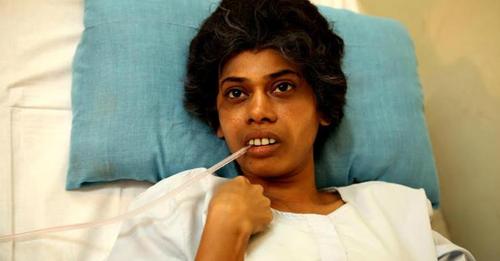
Aruna Ramchandra Shanbaug , was an nurse who was at the centre of attention in a court case on euthanasia after spending over 41 years in a vegetative state as a result of a sexual assault.
In 1973, while working as a junior nurse at King Edward Memorial Hospital, Parel, Bombay Now Mumbai, Shanbaug was sexually assaulted by a hospital janitor, and remained in a vegetative state following the assault. On 24 January 2011, after Aruna Shanbaug had been in this state for 37 years, the Supreme Court of India responded to a plea for euthanasia filed by journalist Pinki Virani, setting up a medical panel to examine her. The court rejected the petition on 7 March 2011. However, in its landmark opinion, it allowed passive euthanasia in India.
Aruna Shanbaug was born ( 1 June 1948) in a Konkani Brahmin family 1948 in Haldipur, Uttar Kannada, Karnataka. At the time of the attack, she was engaged to a doctor employed at the same hospital.
On 27 November 1973, Aruna Shanbaug, then 25 years old, was sexually assaulted by a male sweeper on contract at the King Edward Memorial Hospital. The attack occurred while she was changing clothes in the hospital basement. He choked her with a dog chain and raped her. This cut off oxygen to her brain, resulting in a brain stem contusion, cervical cord injury, and cortical blindness. She was discovered at 7:45 am the following morning by a cleaner.
Sohanlal Bhartha Valmiki was caught and convicted of assault and robbery, and he served two concurrent seven-year sentences, being released in 1980. He was not convicted of rape, sexual molestation, or unnatural sexual offense, the last of which could have been punished with life imprisonment.
Journalist and human rights activist Pinki Virani attempted to track down Sohanlal; she believes that Sohanlal changed his name after leaving prison but continued to work in a Delhi hospital, and since neither the King Edward Memorial Hospital nor the court that tried Sohanlal kept a file photo of him, Virani’s search failed. Other reports claimed he had subsequently died of AIDS or tuberculosis.
Shortly after Shanbaug’s death was announced, however, Sohanlal was tracked down by Mumbai-based journalist Dnyanesh Chavan from Marathi daily Sakal to his father-in-law’s village of Parpa in western Uttar Pradesh. He was found to be still living, married with a family, and working as a labourer and cleaner in a power station. After his release from prison, he returned to his ancestral village of Dadupur in western Uttar Pradesh before moving to Parpa in the late 1980s.
When interviewed, Sohanlal described his version of the assault, claiming it had been committed in a “fit of rage” and that he had no clear recollection of when it had taken place or what he may have done, though he denied raping her and said that it “must have been someone else”. Sohanlal, then a hospital janitor, had a difficult relationship with Shanbaug, his superior. He says that “there was an argument and a physical fight” when Shanbaug refused to give him leave to visit his ill mother-in-law and said that she would write him up for poor work.
Following the attack, nurses in Bombay now Mumbai went on strike demanding improved conditions for Shanbaug and better working conditions for themselves. In the 1980s, the Municipal Corporation of Greater Mumbai made two attempts to move Shanbaug outside the KEM Hospital to free the bed she had been occupying for seven years. KEM nurses launched a protest, and the BMC abandoned the plan.
Aruna Shanbaug died of pneumonia on 18 May 2015, after being in a persistent vegetative state for nearly 42 years.Agency.